
Today is believed to be the birthday of William Shakespeare, born in Stratford-upon-Avon, England, in 1564.
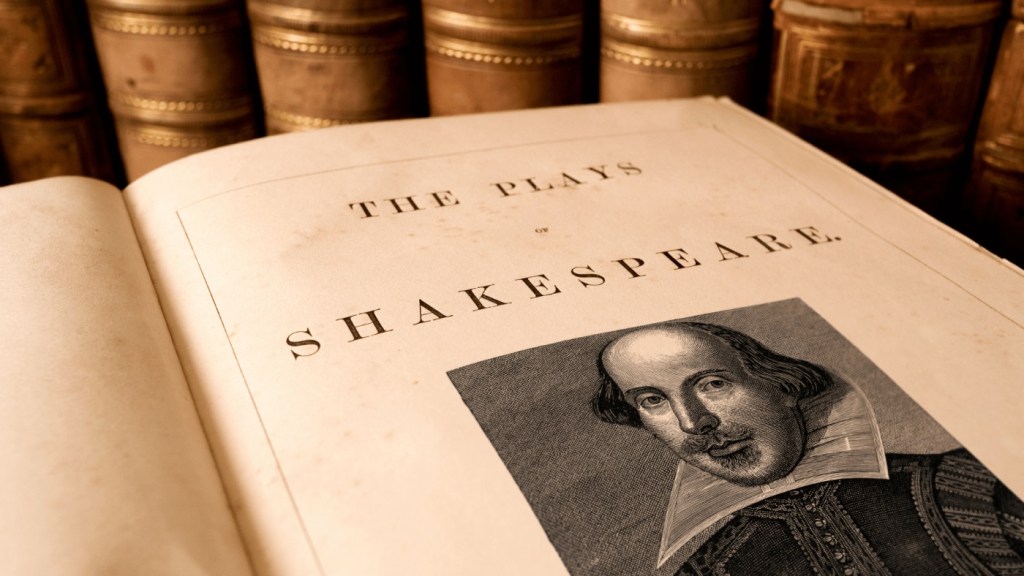
He was a playwright and poet and is considered the most influential — and perhaps the greatest — writer in the English language.
His tragedies have been celebrated for centuries. For example, there’s The Tragedy of Julius Caesar, in which a Roman general thinks he’d like to be emperor, other people disagree, and everyone dies in the end. There is The Tragedy of Macbeth, in which a Scottish thane thinks he’d like to be king, other people disagree, and everyone dies in the end. There is The Tragedy of Richard III, in which a hunchbacked noble thinks he’d like to be king, other people disagree, and everyone dies in the end. There is even The Tragedy of Hamlet, in which a young prince thinks, and everyone ends up as mincemeat.
(That last is naturally set in Denmark, where the relationship between thinking and dying was most famously chronicled by Søren Kierkegaard, who called life itself The Sickness Unto Death. He was a very happy fella.)
He gave us many beloved plays, including Romeo and Juliet (1594), A Midsummer Night’s Dream (1595), Gay Boys in Bondage (1601), Othello (1604), and King Lear (1605). Only a few scattered facts are known about his life. He was born and raised in the picturesque market town of Stratford-upon-Avon, surrounded by woodlands. His father was a glover and leather merchant; he and his wife had eight children, including William, though three of them died in childbirth. William probably left grammar school when he was thirteen years old, but continued to study on his own.
He went to London around 1588 to pursue a career in drama (or to sleep with actresses, or men who dressed like women), and by 1592 he was a well-known actor. He joined an acting troupe in 1594 and wrote many plays for the group while continuing to act. Scholars believe that he usually played the part of the first character who came on stage, but that in Hamlet he played the ghost.
Some scholars have suggested that Shakespeare couldn’t have written the plays attributed to him because he had no formal university education. A group of scientists recently plugged all his plays into a computer and tried to compare his work to that of other writers of his day, such as Francis Bacon, Christopher Marlowe, and the Earl of Oxford. The only writer they found who frequently used words and phrases similar to Shakespeare’s was Elizabeth I, and although Shakespeare had been seen in women’s clothing several times, the Queen was eventually ruled out as well.
Shakespeare used one of the largest vocabularies of any English writer — almost 30,000 words — and he was the first writer to invent or record many of our most common turns of phrase, including foul play, as luck would have it, your own flesh and blood, too much of a good thing, good riddance, in one fell swoop, play fast and loose, and in the twinkling of an eye.
Shakespeare wrote a great many other plays and, in the end, died on April 23, 1616. His accomplishments are all the more remarkable when you consider that he died on the very same day he had been born.
 The Haus of Dcaligari