March 14, 1883 –
“Let the ruling classes tremble at a communist revolution. The proletarians have nothing to lose but their chains. They have a world to win. Workingmen of all countries, unite!”
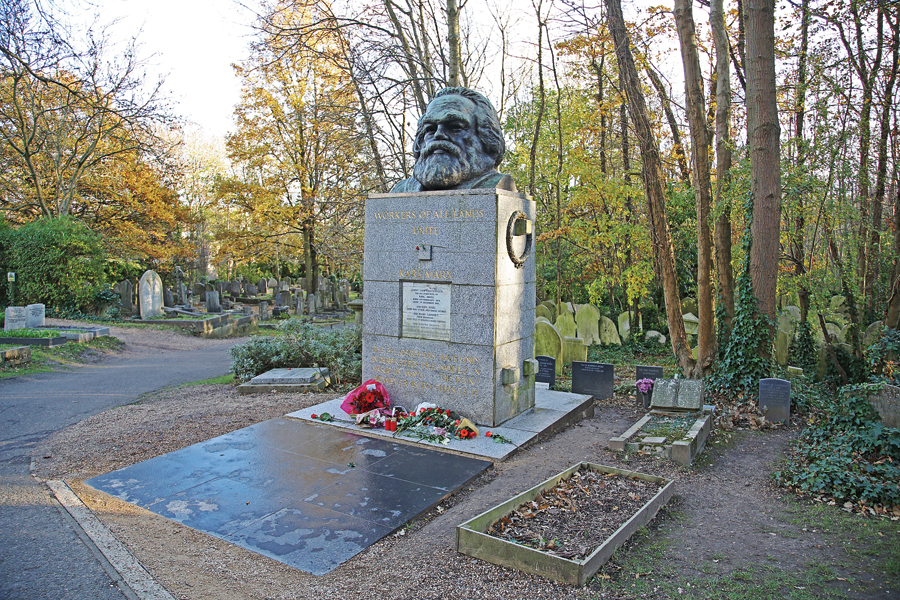
Karl Marx died of pleurisy in London on this date. While his original grave had only a nondescript stone, the Communist Party of Great Britain erected a large tombstone, including a bust of Marx, in 1954.
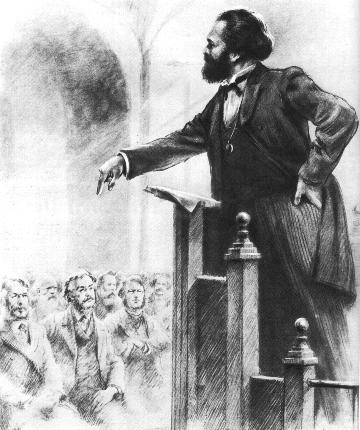
His premature death prevented him from seeing the global impact of his progeny: Groucho, Harpo, Chico, Gummo, and Zeppo. Karl Marx was born in Trier, Prussia, on May 5, 1818. He went to school at a time of severe repression. Pianos had to have skirts on them for fear young men would become aroused by the sight of their bare legs. The Prussian government kept teachers under police surveillance to make sure they wouldn’t teach anything too radical, like 2 + 2 = 4, and so the students, including Marx, became extremely radical.

(There are no known photos of Karl and Gummo together; they never got along.)

As a result of his beliefs, Marx was not able to get a job as a chicken inspector after he got his doctorate in philosophy. Without a job, he spent his time analyzing history and stealing tips left for waiters at the coffeehouses he frequented, and came to the conclusion that all historical events were caused by economic forces.
He became involved in Communism—the belief that all private property should be abolished, men and women should not bathe or shave, and pickled herring should be used as cologne. Marx moved around Europe, writing for newspapers and pornographic pamphlets, studying, and wanting to write a book about his economic ideas. But Marx was an obsessive researcher and never knew when to stop reading and start writing. He only became productive after he met Friedrich Engels, a socialist who was also wealthy—the heir to a textile business and a primitive whoopee-cushion novelty item.
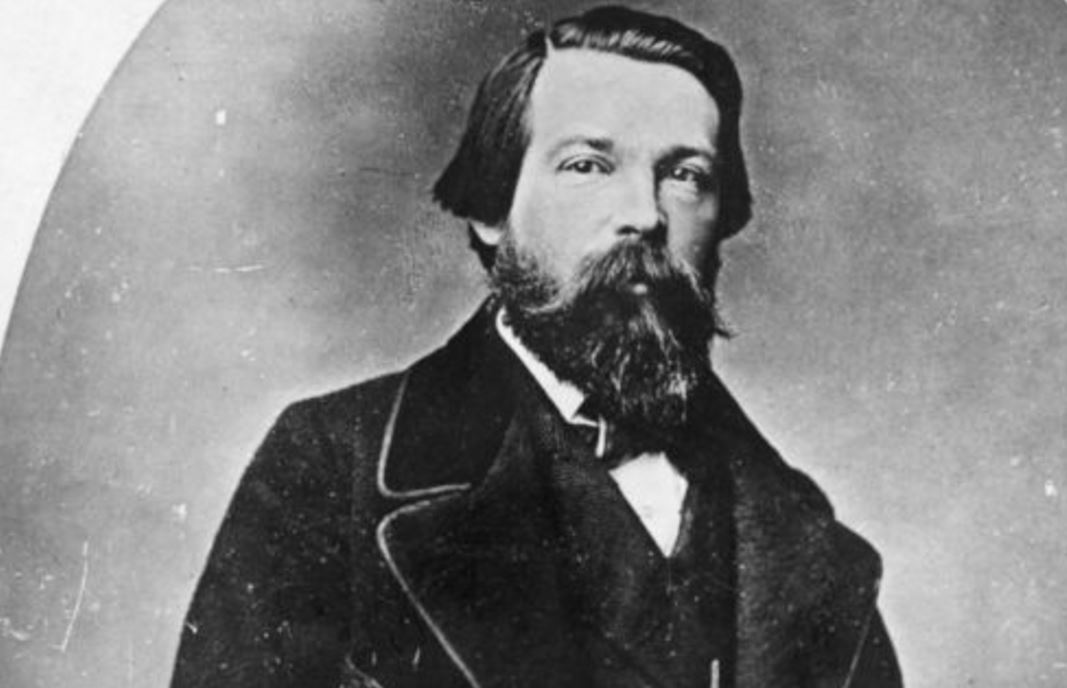
Their main theory was that the economic system was a perpetual conflict between those who controlled the capital and those who provided the labor; that the conflict would never be resolved peacefully; that in a free market workers would periodically lose their jobs, their standard of living would fall, and this would inevitably lead to violent revolution. He believed that giant corporations would dominate the world’s industries and that globalism in trade would make markets even more unstable. He also believed that you could hard-boil an egg by holding it under one’s armpit for a week, thus saving money by not paying the gas bill.
Marx and Engels published their Communist Manifesto and What the Butler Saw Whilst Polishing the Knob in 1848, and revolution did break out afterward in France, Italy, and Austria. Marx’s newspaper was shut down and he had to flee the country. He moved to London, where he worked for years on his final book, Das Kapital. With his family in poverty, Marx said, “I don’t suppose anyone has ever written about ‘money’ when so short of the stuff.” A spy from Prussia was keeping tabs on him and wrote, “Washing, grooming, and changing his clothes are things he does rarely. He does not shave at all. But he does have an unnatural obsession with watching Armenian women clip their toenails!”
He fed his family on bread and potatoes, and when one of his children died, his wife had to borrow money from a neighbor to buy a coffin.
When Marx died in 1883, only 11 persons came to his funeral. And they were all charged a mourner’s tax!
And so it goes
 The Haus of Dcaligari