Today is the sixth day of the Lunar New Year, and the garbage from the first five days of celebrating is piling up. The rubbish from the first to the fourth day of the Lunar New Year is considered “wealth,” but after the fifth day, that garbage becomes a sign of “poverty.” So, on the sixth day of the Lunar New Year, families participate in a traditional ritual called “Sending Away Poverty” (Song Qiong). This day marks a symbolic transition from the festive restrictions of the New Year to the resumption of normal life and work. The God of Poverty is believed to visit each household.
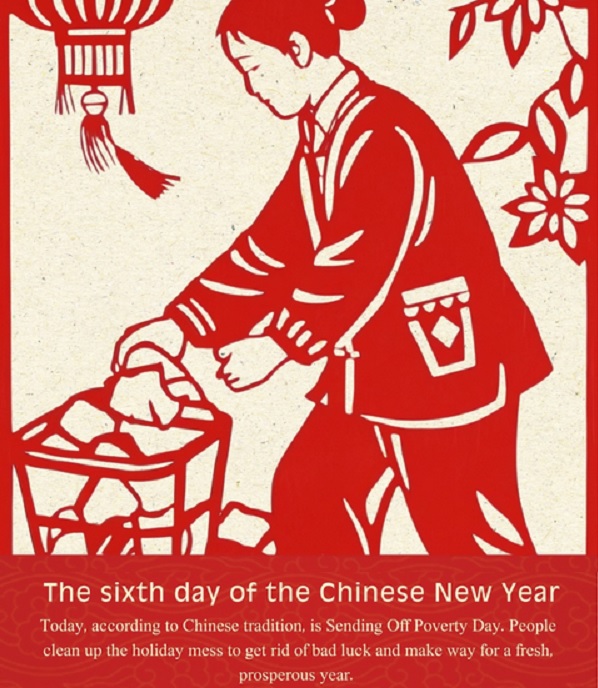
According to Chinese folklore, the God of Poverty was the son of the ancient Emperor Zhuanxu, one of the legendary rulers among the Three Sovereigns and Five Emperors of ancient China.

He was said to be short and weak, fond of wearing ragged clothes and living on a diet of coarse porridge. Even when people presented him with new clothes, he would not wear them until he had ripped them apart or burned them. Because of this, he was called “the man of poverty,” and over time, he gradually came to be regarded as the ghost of poverty.
In the legend of Nüwa, the sixth day of the Lunar New Year is also the Birthday of the Horse.
The horse is one of the “six domestic animals” (Liu Chu) that were critical to ancient Chinese agriculture and survival. On this day, rituals and beliefs focus on honoring the animal’s contribution to society.

According to tradition, today is also known as “Pouring Out Manure Day” (Yi Fei). Families clean their toilets because the God of Toilets is said to come and inspect the cleanliness of the household.

In an agricultural society, before modern plumbing, Chinese farmers would have someone clean the manure pit every three to five days. The sixth day was designated for this task. (And yes, it always stinks when you have to clean the manure pit.)
 The Haus of Dcaligari