
January 19, 1809 –
It’s the birthday of the poet and short-story writer Edgar Allan Poe, born in Boston on this date. He was the son of two actors, but since he was Edgar Allan Poe, both of his parents died of tuberculosis when he was just a boy. He was taken in by a wealthy Scotch merchant named John Allan, who gave Edgar Poe his middle name.
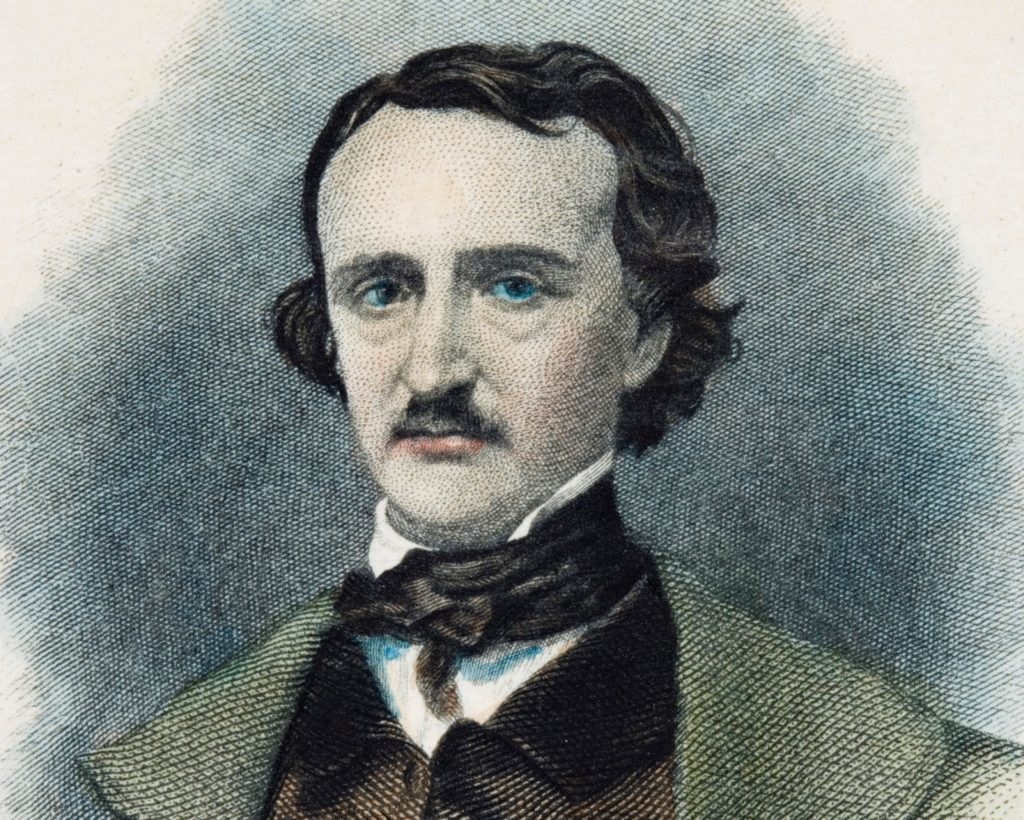
His foster father sent him to the prestigious University of Virginia, where he was surrounded by the sons of wealthy slave-owning families. He developed a habit of drinking and gambling with the other students, but his foster father did not approve. Poe and John Allan had a series of arguments about his behavior and his career choices, and Poe was eventually disowned and thrown out of the house. Sometimes, we all make bad choices.
He spent the next several years living in poverty, depending on his aunt for a home and supporting himself by writing anything he could, including a how-to guide for seashell collecting and picking the pockets of the dead at funerals. Eventually, he began contributing poems, journalism, and even helpful cleaning tips to magazines. At the time, magazines were a new literary medium in the United States, and Poe was one of the first writers to make a living writing for them. He called himself a magazinist.
He first made his name by writing some of the most brutal book reviews ever published. He was known as the “tomahawk man from the South.” He once described a poem as “an illimitable gilded swill trough,” and remarked that “[most] of those who hold high places in our poetical literature are absolute nincompoops.” He particularly disliked the work of Henry Wadsworth Longfellow and John Greenleaf Whittier.
Poe also began publishing fiction, specializing at first in humorous and satirical stories, since that was the style most in demand. Once again, remember this is Edgar Allan Poe – so soon after he married his fourteen-year-old cousin, Virginia, he learned that she had tuberculosis, just like his parents. He soon began writing darker stories. One editor complained that Poe’s work was becoming too grotesque, but Poe replied that the grotesque would sell magazines. He was right. His work helped establish magazines as the major new venue for literary fiction.
But even though his stories sold magazines, Poe never made much money. He earned about $4 per article and $15 per story, and magazines were notoriously late with their payments. There was no international copyright law at the time, so his stories were printed throughout Europe without his permission. There were periods when he and his wife lived on bread, molasses, and dust bunnies, selling most of their belongings to the pawn shop.
It was under these conditions – suffering from alcoholism and watching his wife’s health slowly deteriorate – that Poe wrote some of the greatest Gothic horror stories in English literature, including The Tell-Tale Heart and The Fall of the House of Usher. Near the end of his wife’s illness, he published the poem that begins:
Once upon a midnight dreary, while I pondered, weak and weary,
Over many a quaint and curious volume of forgotten lore—
While I nodded, nearly napping, suddenly there came a tapping,
As of some one gently rapping, rapping at my chamber door….
On October 7, 1849, Edgar Allan Poe was found in a delirious state outside a Baltimore voting place (a saloon), in Maryland.
Mr. Poe was often found delirious, especially outside voting places—but this time his delirium was serious, and he died.
And so it goes
 The Haus of Dcaligari