September 12, 490 B.C. –
It looked like it was going to be a pretty bleak day for Western Civilization. The Greeks, who were not yet “Ancient” or “Classical,” were facing a massive invasion by the Persians. Persia was not yet part of the Axis of Evil, but it was pretty nasty just the same. They had more soldiers than the Greeks, better cavalry, and superior weapons. (They did not, however, have ouzo, moussaka, or the mastery of sodomy; it may have been envy of those quintessentially Greek achievements that drove them to invade.)
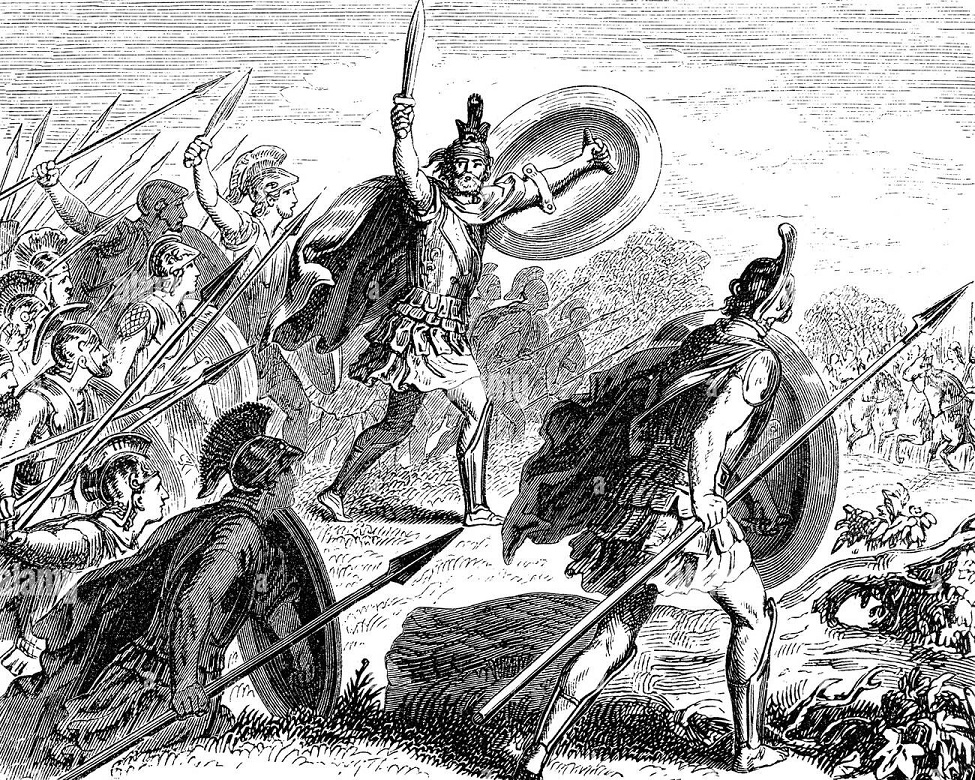
The general in charge of the Greeks was the Athenian Miltiades, also known as Uncle Milti.

In addition to his own Athenians, he had been given Plataean soldiers and the promised support of the Spartans. It was the first time the various city-states had prepared to fight together against a common enemy.
Despite his strong defensive position, entrenched in the hilly terrain of Marathon, Uncle Milti feared that the Persians’ superior numbers would allow them to break through the Greek defenses and destroy Western Civilization. To prevent this, he launched an offensive.
It caught the Persians off guard, driving them off the land, into their ships, and back to Persia.
This was the Battle of Marathon, at which Western Civilization was saved for the first time—ensuring a future for diet cola, fat-free potato chips, and pay-per-view sports. (The Battle of Marathon is not related to the Marathon Bar or Marathon Man, but neither could have come about without it.)
A special note to the strange people who run marathons: After the battle, a runner, the soldier Pheidippides, was sent back to Athens to announce the victory.

Racing about 140 miles to get there, Pheidippides delivered the momentous message Niki! (“Victory!”), then promptly collapsed and died—thereby setting a precedent for dramatic marathon finishes and the first sports product endorsement.
The modern Olympic Games introduced a “marathon” race of 40,000 meters (24.85 miles). The winner was Spiridon Louis, a Greek postal worker from the village of Marusi and a veteran of several long military marches. His time was 2 hours, 58 minutes, 50 seconds for the 40-kilometer distance – an average pace of 7:11 minutes per mile.
At the 1908 Olympic Games in London, the marathon distance was changed to 26 miles to cover the route from Windsor Castle to White City Stadium, with 385 yards added so the race could finish in front of King Edward VII’s royal box. After 16 years of heated discussion, this 26.2-mile distance was officially established at the 1924 Olympics in Paris.
And so it goes.
 The Haus of Dcaligari