July 21, 1969 –
Apollo 11 astronauts Neil Armstrong and Edwin “Buzz” Aldrin blast off from the Moon after twenty-one and a half hours on the surface and return to the command module piloted by Michael Collins on this date.
The lunar module’s lower section, left behind, has a plaque mounted upon it, reading, “Here men from the planet Earth first set foot upon the moon, July 1969 A.D. We came in peace for all mankind.”
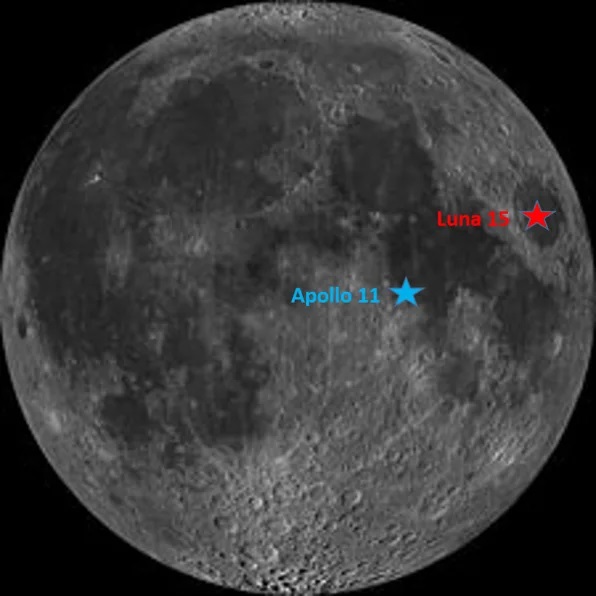
While all of the world is celebrating the success of the Apollo 11 mission; a little remembered incident also occurred 52 years ago this week, the Soviets nearly landed an unmanned vehicle on the Moon first, Luna 15. The USSR had ambitious lunar landing and exploration plans. The country’s “Luna” space program – envisaging the launch of interplanetary spacecraft to the Moon – appeared in 1958, earlier than NASA’s Apollo program. Yuri Gagarin’s first manned space flight in 1961 only strengthened the Soviet belief that it was their destiny to dominate space. And for a while, it seemed they would. The five-ton Soviet station (Luna 15 was launched Sunday, July 13,) approached the Moon on July 17, three days before the now airborne Apollo 11, and went into near-lunar orbit. But then, the unforeseen happened. For some reason, the spacecraft got stuck in lunar orbit, allowing Apollo 11 to sneak past.
As the first men on the Moon prepared to launch from the lunar surface, astronomers at the Jodrell Bank Observatory in Manchester heard commands being sent up to Luna 15 from Moscow. The Soviet spacecraft was beginning its 52nd orbit and preparing to descend towards the surface … it wasn’t until this moment the English astronomers realized the craft was designed to land. They tracked the spacecraft in real time as it sped towards the surface, listened as it gained speed and finally crashed right into Mare Crisium, the Sea of Crises, about two hours before Armstrong and Aldrin we set to leave the lunar surface.
“I say, this has really been drama of the highest order,” remarked one Jodrell Bank astronomer when it was all over.
And so it goes.
 The Haus of Dcaligari