
July 11, 1533 –
The Church of England came into being on this date. The story of its origins is shrouded in sex and therefore important.
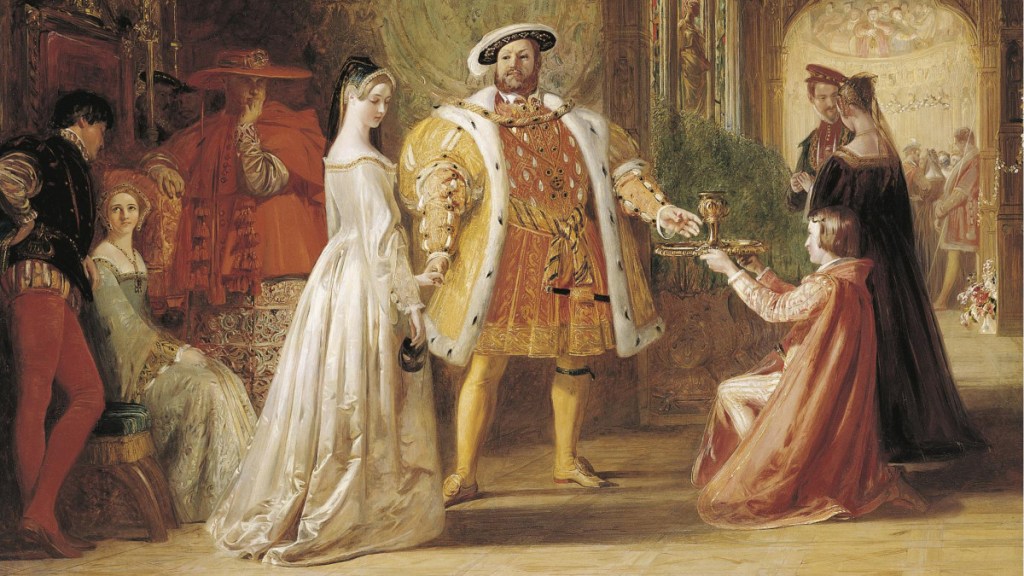
Henry VIII assumed the English throne in 1509, an energetic young man of seventeen. He immediately decided to have a male heir. This became the enduring theme of his reign and he consequently came to be known as The Son King (or, to his detractors, The Heir Head.)
Henry such a devout Catholic that he earned the title “Defender of the Faith” without even stepping into the ring. His first wife, whom he’d married before taking the throne, was Catherine of Aragon, who earned the nickname “Catherine of Aragon.” Catherine was an excellent queen until she didn’t have a son, at which point things changed.
By the 1530s Henry had realized he was married to a bad queen. He was now about 40 years old and therefore decided to get a convertible couch and a new wife.
The convertible caused no problems, but the changing of wives required the official permission of the Pope, who, being Catholic himself, refused to grant a divorce.
Henry divorced her anyway, and on July 11, 1533, the Catholic Church seceded from the Church of England in retaliation.
The Pope having withdrawn, Henry made himself the head of the Church of England. Because he was still the Defender of the Faith, he wrote the Act of Supremacy. This Act proved that the Church of England was better than the Catholic Church, that King Henry VIII was better than any Pope, and that a Single White King was back in the market.
Sir Thomas More had been the Lord Chancellor of England, and knew Henry as well as any man alive. He therefore refused to swear to the Act of Supremacy, and on July 6, 1535, became Sir Thomas Somewhat Less.
At this point in his career, Henry began marrying and divorcing women on a regular basis. The divorce process was expedited now that Papal authority was no longer a consideration. In fact, Henry turned the entire process into a game: his wives would be blindfolded and asked to produce a male heir.
It came to be known as “Bluff King Hal,” and several centuries later it served as the inspiration for the popular French game, “Hungry Hungry Guillotine.“
And so it goes
 The Haus of Dcaligari